L.O.S.S. Postvention Teams History and Map
This section of the Local Outreach to Suicide Survivors (L.O.S.S.) Team consulting website includes information about L.O.S.S. postvention teams and a map of where to find them in the U.S. The “Where Do I Begin?” section of the website also includes a L.O.S.S. Team launch checklist.
Creating Suicide Prevention Community Coalitions: A Practical Guide
This guide from Know The Signs provides a step by step approach to creating suicide prevention coalitions, including 1) exploring purpose, 2) recruiting the right people, 3) developing a successful structure, 4) implementing activities, and 5) maintaining engagement. It features examples from California counties.
CDC Guidance for Community Assessment and Investigation of Suspected Suicide Clusters
This CDC report provides guidance on assessing and investigating suspected suicide clusters. It guides lead agencies in determining if a suicide cluster exists, community concerns, and specific characteristics of the suspected or confirmed suicide cluster. It is part of a three-report series on suicide clusters and responding.
A Primer for Multi-Sector Health Partnerships in Rural Areas and Small Cities
A tool to guide cross-sector collaborations between the community development, finance, public health, and healthcare sectors to support partnerships in rural areas and small cities.
Developing Partnerships in Rural Communities: At the Intersection of Suicide Prevention, Overdose, and Adverse Childhood Experiences
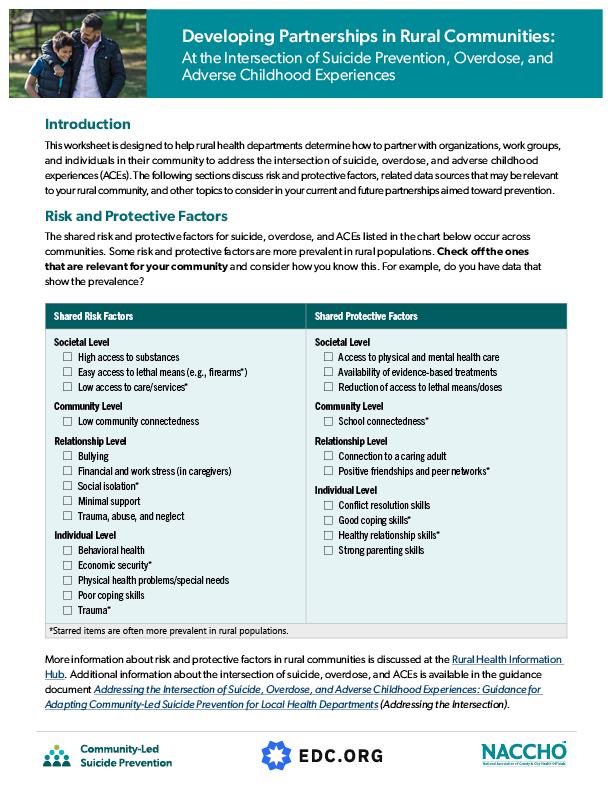
This worksheet is designed to help rural health departments determine how to partner with organizations, work groups, and individuals in their community to address the intersection of suicide, overdose, and adverse childhood experiences. It discusses risk and protective factors, data sources that may be relevant in a rural community, and other topics to consider in […]
Department of the Air Force Integrated Resilience – Suicide Prevention
This web page highlights the United States Air Force’s present-day suicide prevention strategies and resources, including its 15 program elements.
CARES Community Health Needs Assessment Generator
This University of Missouri Extension website allows users to pull data into easy to navigate reports for their state and county. State and county data included in reports include demographics, social determinants of health such as income and education, health behaviors, and health outcomes– including suicide death rates.
Principles for Advancing Equitable Data Practice
This brief presents principles for equitable data practice across data collection, analysis, interpretation, and dissemination. The recommendations for equitable data practice are organized by the research principles of beneficence, respect for persons, and justice.
The Data Equity Framework
This framework provides 7 steps for increasing equity within efforts to collect, analyze, interpret, and communicate on data. It provides an overview of the 7 steps, free online tools, a forum, and newsletter to support communities in advancing equitable data.
Addressing the Intersection of Suicide, Overdose, and Adverse Childhood Experiences
This guidance document provides information for adapting the key elements of the Community-Led Suicide Prevention Toolkit to assist local health departments and partner organizations in taking a community-led approach to working at the intersection of suicide, overdose, and ACEs.